Entering the state of Ihram is one of the most important steps in performing Umrah. It is not just about wearing two plain white sheets or specific clothing; it is a spiritual state of purity, discipline, and devotion to Allah ﷻ. Once a person enters Ihram, certain actions become forbidden, and breaking these rules intentionally can affect the validity or reward of the Umrah.
For many UK Muslims travelling for Umrah, especially first-timers, confusion often arises about what actually breaks Ihram and what is simply disliked or discouraged. This guide explains everything in a simple, practical way so you can perform your Umrah with confidence and peace of mind.
What is Ihram?
Ihram is a sacred state entered before performing Umrah or Hajj. It begins with intention (niyyah) and Talbiyah:
“Labbayk Allahumma Labbayk…”
Once a person enters the Ihram, they are expected to avoid certain actions that maintain the sanctity of this worship.
It is important to understand that Ihram is not only clothing, but it is also a mindset of humility, patience, and complete submission to Allah ﷻ.
The Conceptual Framework: Prohibitions vs. Invalidation
Before examining individual restrictions, it is essential to distinguish between two terms often confused by pilgrims: violating an Ihram prohibition and completely invalidating the Umrah itself. In the schools of classical fiqh, most prohibited actions do not instantly cancel your Umrah out of existence; rather, they are major or minor transgressions that incur a spiritual sin if done intentionally and require specific legal penalties (such as sacrificing a sheep or feeding the poor) to patch the spiritual defect.
There is, however, one supreme action that completely voids and destroys the validity of your Umrah rituals from the root, requiring you to repeat the entire journey from the beginning.
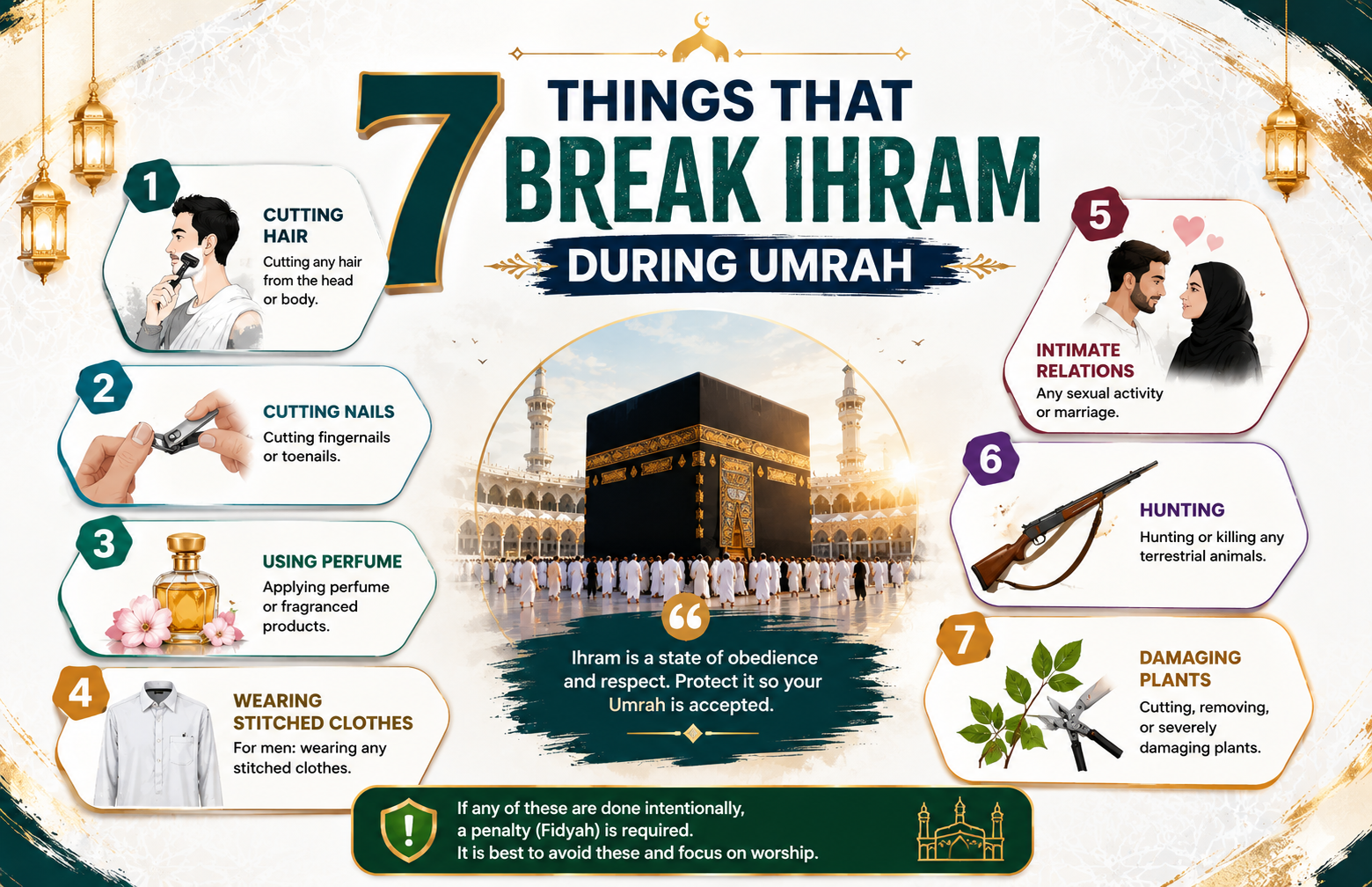
7 Things That Break Ihram (Major Violations)
Below are the actions that either break Ihram or require serious compensation (fidyah) if done intentionally.
1. The Ultimate Violation: Marital Intimacy (Intercourse)
The single act that completely breaks, invalidates, and ruins the legal validity of your Umrah is engaging in sexual intercourse or marital intimacy before the completion of your Sa’i and subsequent hair cutting. Allah the Almighty states in the Holy Qur’an:
فَمَن فَرَضَ فِيهِنَّ الْحَجَّ فَلَا رَفَثَ وَلَا فُسُوقَ وَلَا جِدَالَ فِي الْحَجِّ
“…So whoever has made Hajj obligatory upon himself therein [by entering Ihram], there is [to be] no sexual relations and no disobedience and no disputing during Hajj…” (Surah Al-Baqarah, 2:197)
If a pilgrim intentionally violates this absolute boundary while in Ihram for Umrah, the legal consequences are severe:
- The current Umrah is completely nullified and deemed invalid.
- Despite the invalidation, the pilgrim is required by fiqh to continue and finish the rest of the physical actions of the invalid Umrah (Tawaf and Sa’i) out of respect for the holy land.
- A major penalty (Dam) must be offered, which involves the slaughter of a sheep within the boundaries of the Haram in Makkah, with the meat distributed entirely to the poor.
- The pilgrim is strictly required to make up for this broken pilgrimage by travelling back to the Miqat and performing a completely new Umrah (Qada) to replace the nullified one.
2. Shaving, Trimming, or Removing Hair
Once your intention for Ihram is set, you are strictly forbidden from deliberately cutting, shaving, plucking, or breaking off any hair from any part of your body, be it your head, beard, moustache, underarms, or pubic region. The hair must remain completely undisturbed until the very end of the pilgrimage, where cutting it serves as the formal ritual exit from Ihram.
The Common British Pilgrim Dilemma: Accidentally losing hair while showering. Many brothers and sisters worry when they look down at the hotel drain or their hands while making Wudu and find stray hairs that have naturally fallen out. Traditional scholars clarify that if hair falls out entirely on its own through gentle washing, foaming, or scratching without any deliberate intent to sever it, there is absolutely no sin or penalty incurred. The prohibition is explicitly against purposeful removal.
Sisters have distinct guidelines regarding clothing materials, headcoverings, and modesty boundaries. Read our companion piece on Comprehensive Ihram Rules for Women.
3. Clipping or Cutting Nails
Similar to the ruling on hair, clipping, cutting, or biting your fingernails or toenails while in Ihram is prohibited. This is an act associated with ordinary worldly grooming and luxury, which the pilgrim must intentionally shed to experience the deep humility of Ihram.
If a nail splits or breaks accidentally during travel, perhaps while lifting heavy luggage at the King Abdulaziz Airport terminal and causes genuine physical pain or catches on your clothing, you are fully permitted to trim away only the broken, dangling piece causing the discomfort. No penalty or sin applies in this specific scenario because it is done to alleviate harm rather than for aesthetic grooming.
4. Applying Perfume, Fragrances, and Scented Cosmetics
The application of any form of added fragrance to your body, your Ihram sheets, or your clothing after making the intention for Ihram is completely forbidden. This includes standard colognes, perfumes, scented body lotions, and traditional attar. The Prophet (peace and blessings be upon him) explicitly commanded that a pilgrim should not wear garments that have been touched by saffron or wars (fragrant plants).
For modern pilgrims from the UK, this requires vigilant scanning of toiletries. You must avoid using:
- Standard hotel soaps, body washes, or shampoos are provided in Makkah.
- Scented wet wipes, hand sanitisers, or facial moisturisers.
- Scented laundry detergents when washing your Ihram sheets.
To avoid complications, always purchase explicitly unscented, fragrance-free Hajj/Umrah kits before leaving the UK. These are widely available in Islamic bookshops across London, Birmingham, and online retailers.
5. Wearing Sewn or Tailored Garments (Strictly for Men)
For male pilgrims, wearing any clothing item that has been stitched, tailored, woven, or formed to fit the contours of the human anatomy is a direct violation of Ihram. This means no t-shirts, no trousers, no jackets, and crucially, no stitched underwear or socks.
The Ihram for men must consist solely of two unstitched pieces of cloth. They can secure their lower sheet with a belt or money pouch, even if that belt has stitching on it, as long as the belt itself is not a garment fitting a limb. Sandals or shoes worn by brothers must leave the ankles and the top arch of the foot completely exposed.
Are you unsure about the precise garments, intentions, and entry procedures? Ensure you meet all requirements by consulting our dedicated guide on Essential Ihram Rules for Men.
6. Covering the Head (For Men) and Covering the Face (For Women)
The rules of coverage differ significantly between genders to preserve separate Sunnah instructions:
- For Men: It is forbidden to cover the head with anything that wraps around or directly rests upon it, such as a cap, a turban, a hoodie, or even resting your top Ihram sheet over your head to shield yourself from the intense Saudi heat. Umbrellas are fully permitted, as they shield from heat without directly covering the head.
- For Women: The face must remain completely uncovered. The Prophet (peace and blessings be upon him) stated that a woman in Ihram must not wear a niqab (face veil) or gloves. If sisters find themselves in an intensely crowded environment where they prefer to maintain facial privacy in front of non-mahram men, they are permitted to use a cap or headband that extends a stiff brim forward, allowing a fabric veil to hang down in front of the face without actually touching the facial skin.
7. Hunting, Harming, or Killing Animals and Insects
The state of Ihram is a state of universal peace. While inside the sacred boundaries of the Haram, and especially while dressed in Ihram, you are prohibited from hunting wild land animals, aiding anyone else in hunting them, or destroying the indigenous plants and trees of Makkah.
What about insects like mosquitoes or flies? If an insect or pest is actively causing you harm or threatening your health (such as a wasp or a mosquito biting you), you are permitted to swat or kill it to protect yourself. However, you should not go out of your way to deliberately kill harmless insects crawling on the floor or walls of your hotel or the Mas’a corridor.
What Does NOT Break Ihram (Common Misconceptions)?
Many pilgrims worry unnecessarily about small actions. These do NOT break Ihram:
- Taking a shower (without fragrance)
- Changing Ihram cloths
- Sleeping
- Eating and drinking
- Using unscented soap
- Accidentally smelling perfume
- Carrying mobile phones or luggage
- Sitting under shade or umbrellas
These are all allowed and do not affect Ihram.
Understanding Penalties: What Happens if a Boundary is Crossed?
If you discover that you have accidentally or intentionally broken one of these restrictions (excluding marital intimacy, which requires a full remake of the Umrah), Islamic law outlines a clear path of rectification based on the nature of the violation:
The Intentional Violation (Due to Necessity or Ignorance)
If you had to cross a boundary due to a genuine medical condition, for instance, if a doctor required a brother to wear fitted compression socks due to deep vein thrombosis on a long flight, the pilgrim must offer a choice of expiation known as Fidyah al-Adha:
- Slaughtering a sheep within Makkah to feed the poor; OR
- Feeding six poor people within the boundaries of the Haram; OR
- Fasting for three days (which can be done in Makkah or upon returning home to the UK).
The Purely Accidental Violation
If a pilgrim genuinely forgot they were in Ihram and habitually used a heavily scented hand sanitiser after using the restroom, or if an elder unthinkingly put on a cap to protect themselves from the sun, they must immediately remove the violation the second they remember. According to the strongest jurisprudential views, if an action was genuinely done out of total forgetfulness, pure ignorance, or a genuine accident and was corrected immediately upon remembrance, there is no sin and no financial penalty (Fidyah) required, though sincere Istighfar is always encouraged.
How to Avoid Breaking Ihram Rules?
Here are simple tips for UK pilgrims:
- Learn the rules before travelling
- Avoid scented products completely
- Keep the Ihram guide notes with you
- Travel with knowledgeable group leaders
- Stay mindful of actions and speech
- Focus on dhikr and dua
Preparation is key to a peaceful Umrah experience.
Final Thoughts
Ihram is a sacred condition that transforms a Muslim into a state of complete devotion to Allah ﷻ. It teaches simplicity, discipline, and awareness of every action.
For UK Muslims performing Umrah, understanding what breaks Ihram is essential to avoid mistakes and ensure the pilgrimage is accepted and spiritually rewarding.