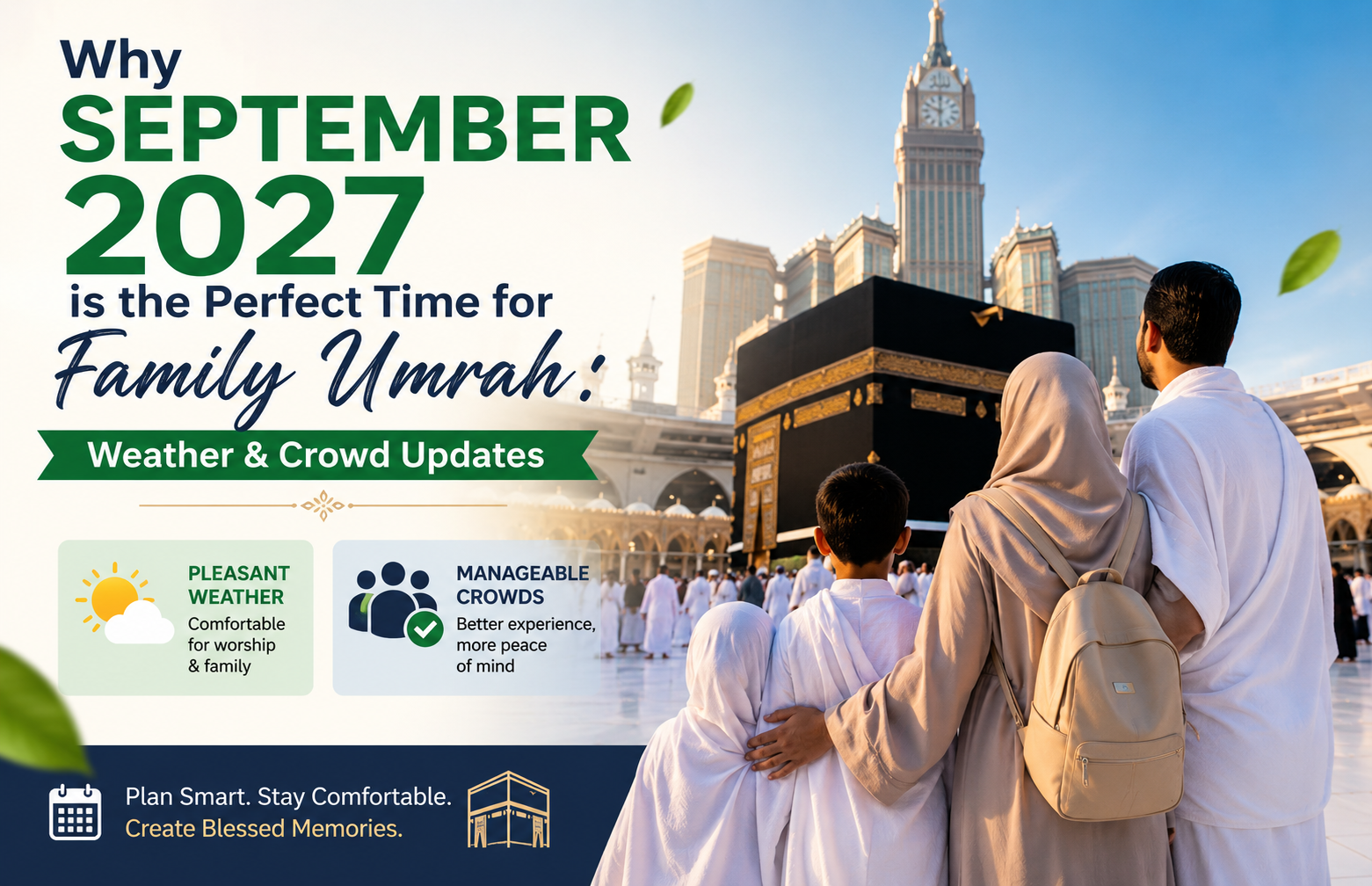
Planning a family Umrah in September 2027 requires balancing weather, crowd levels, travel costs, and school schedules. September falls outside the main Ramadan and Hajj periods, which can make it an attractive option for families seeking a calmer pilgrimage experience. However, temperatures can still be warm, and families with school-age children need to consider term-time travel.
A quick note before we get into it. Exact Hijri dates always depend on moon sighting, so anything tied to the Islamic calendar can shift by a day or two. And while weather and crowd patterns follow fairly predictable yearly cycles, nobody can promise exact numbers over a year ahead of time. What follows is based on how September has typically played out in recent years, and where it sits on the Islamic calendar for 2027 specifically.
Where does September 2027 Falls on the Islamic Calendar?
This is the part that makes September 2027 genuinely well placed for families, not just a random month that happens to sound nice.
Ramadan 2027 is expected in February, with Eid al-Fitr following in early March. Hajj is expected around mid-May 2027. That means by the time September rolls around, you’re roughly four months clear of Hajj season and still around five months out from the next Ramadan.
In Hijri terms, September 2027 lands around Rabi’ al-Thani, which sits comfortably in the quieter stretch of the Islamic calendar. There’s no major pilgrimage season pulling millions of extra people into Makkah and Madinah at the same time. For a family trying to move through Tawaf without getting swept into a crushing crowd, or trying to find a hotel room without paying a peak season premium, this timing matters a lot.
Weather: Better Than Summer, Not Quite Winter
Let’s be honest about the weather rather than oversell it. September in Saudi Arabia is still warm. It sits at the tail end of the hottest stretch of the year, and early September can still bring some genuinely hot days, particularly in Makkah.
That said, it’s a real improvement over the peak of summer. June, July, and August regularly push past 40 degrees, sometimes touching 45 during the afternoon, which is genuinely difficult for young children or elderly family members to manage outdoors. By September, that intensity starts easing off, especially as the month goes on. Mornings and evenings become more comfortable, and the harshest midday heat becomes more manageable if you plan your outdoor movement around it.
Madinah tends to feel slightly more forgiving than Makkah during this period too, so if your itinerary includes a longer stay there, that part of the trip should feel a bit gentler on the whole family.
The practical takeaway is simple. Plan your Haram visits and Ziyarat trips for early morning or after Maghrib, rest during the hottest part of the afternoon, and September becomes very manageable, especially compared to the true peak of summer.
Crowd Levels: The Real Advantage
This is where September earns its reputation as a strong month for families specifically. Because it sits well outside both Ramadan and Hajj season, the crowds at Masjid al-Haram and Masjid an-Nabawi are noticeably lighter than during those peak periods.
For a family with young children, this matters more than people realise before their first trip. A quieter Tawaf means less risk of a child getting overwhelmed or separated in a crush of people. It means shorter waits to get close enough for a clear view during prayer, and generally more breathing room to move at a pace that suits your slowest family member rather than being swept along by the crowd.
Hotels also tend to have better availability during this window, which gives families more choice over room type and location rather than settling for whatever is left. A family suite or connecting rooms close to the Haram are far easier to secure outside of peak season.
The Honest Trade-Off: School Term
Here’s the part that deserves a straight answer rather than a sales pitch. September is not a school holiday month in the UK. If you have children in primary or secondary school, taking them out for an Umrah trip during term time means requesting authorised absence, and not every school grants it easily.
This doesn’t make September a bad choice for every family. It simply means it suits certain families more than others. If your children are pre-school age, or you’re able to arrange authorised leave, or you’re travelling as an extended family without school-age kids involved, September genuinely offers one of the best combinations of weather and crowd levels in the whole year. If school attendance is a hard constraint for your family, it’s worth weighing that against the comfort and cost benefits honestly before committing to this particular month.
Cost Benefits for Families
Because September falls outside Ramadan, Hajj, and the main UK summer holiday period, prices for flights, hotels, and full family packages tend to be noticeably more reasonable than the peak windows. For a family booking multiple rooms or a larger group, this difference adds up fast, sometimes freeing up enough of the budget to upgrade to a hotel closer to the Haram, which matters even more when you’re managing children and less mobile family members.
Booking flights and Umrah packages a few months ahead, rather than waiting until closer to travel, still helps even in a quieter month like September, since prices tend to creep upward as the date approaches regardless of season.
Tips for Making the Most of a Family Umrah in September
Keep these practical tips in mind when planning a family Umrah in September:
Time your Haram visits carefully. Early morning and the hours after Maghrib tend to be cooler and calmer, which suits children and elderly family members far better than a midday visit.
Choose a hotel within easy walking distance. With lighter crowds, a short walk to the Haram is far more manageable for children than it would be during a packed Ramadan crowd, but keeping the distance short still reduces overall fatigue for the whole family.
Pack for both heat and comfort. Light, breathable clothing, a reliable water bottle for each family member, and sun protection are still essential in September, even though the worst of summer has passed.
Build in rest days. Family trips move at a different pace than solo ones. Planning a slower schedule, with breaks between rituals rather than packing everything into back to back days, tends to keep everyone, especially children, in a better mood and more present during worship.
Check school policy early if it applies to you. If you’re considering pulling children out of school for the trip, start that conversation with the school well in advance rather than close to your travel dates.
Room for Ziyarat Without the Rush
Lighter crowds don’t just help at the Haram itself. They make a real difference for family Ziyarat trips too, whether that’s visiting historical sites around Makkah or spending time near Masjid Quba and Mount Uhud in Madinah. During peak season, these sites can get just as crowded as the main mosques, which makes it hard to give children the space to actually look around and ask questions rather than being hurried along by a guide trying to keep a large group moving. A quieter September gives you more freedom to slow down, explain the history and significance of each site properly, and let the trip feel educational rather than rushed.
How Does September Compare to Other Family-Friendly Months?
September isn’t the only reasonable choice for a family trip, and it’s worth being honest about that too. Winter months like January and February often get recommended for similarly comfortable weather, and they carry the added benefit of sitting closer to UK school holiday periods around Christmas and February half term. The trade-off is that winter, particularly December, tends to be busier and more expensive precisely because more families are trying to travel at the same time. September offers a version of that same comfort and lighter crowd benefit, just without the school holiday overlap, which is exactly why it tends to work best for families who have some flexibility around term time.
Final Thought
September 2027 lines up well for families mainly because of what it avoids rather than what it actively promises. It avoids the extreme heat of peak summer, avoids the overwhelming crowds of Ramadan and Hajj season, and avoids the inflated pricing that comes with both. For families who can manage the school term question, or who don’t have that constraint in the first place, September Umrah packages can offer a genuinely calmer, more affordable, and more physically manageable version of Umrah than most other times of the year. As always, keep an eye on official moon sighting announcements as the date approaches, since exact Hijri timing can shift slightly from year to year.