Sa’i between Safa and Marwah is one of the most important rites of Umrah and Hajj. It is not just a physical walk between two hills inside the sacred mosque but a powerful act of worship that carries deep meaning, history, and reflection. Every step reminds a believer of the struggle and trust of Hazrat Hajar (RA), the wife of Prophet Ibrahim (AS), and her unwavering reliance upon Allah ﷻ.
For Muslims in the UK preparing for Umrah, understanding Sa’i properly helps you perform it with calmness, focus, and spiritual awareness rather than confusion or rush. This guide will walk you through everything step by step in a simple, practical way.
What is Sa’i in Umrah?
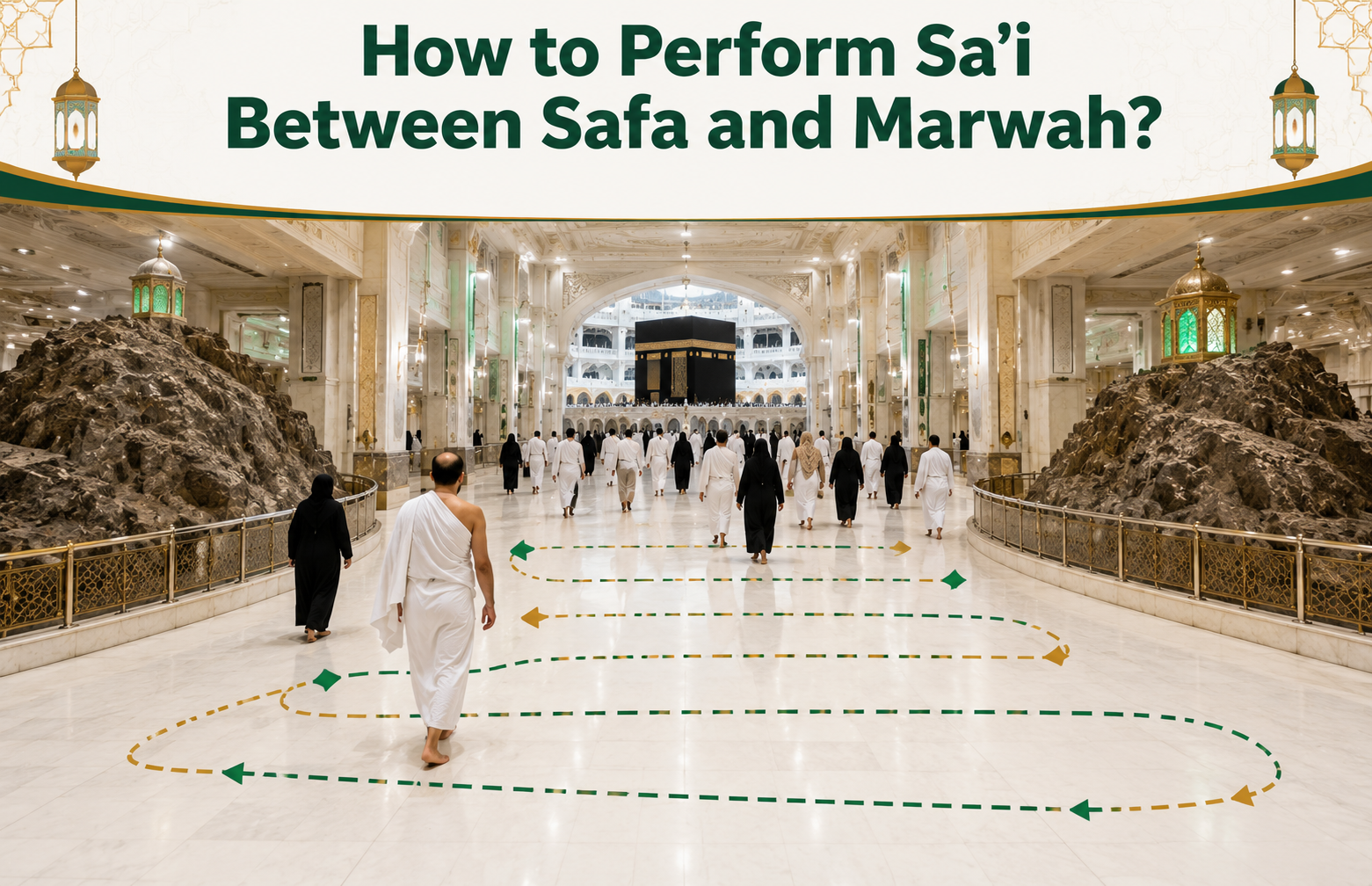
Sa’i means walking seven times between the two small hills known as Safa and Marwah, located inside the sacred mosque in Makkah, known as the Masjid al-Haram.
It is performed after Tawaf (circling the Kaaba) and is an essential pillar of Umrah. Without Sa’i, the Umrah is incomplete.
The act of Sa’i represents patience, trust in Allah, and sincere effort while relying completely on divine help.
The Historical Meaning Behind Sa’i
Before understanding how to perform Sa’i, it is important to understand why it is done.
The origin goes back to Hazrat Hajar (RA), the wife of Prophet Ibrahim (AS). When she was left in the barren valley of Makkah with her infant son Hazrat Ismail (AS), she searched desperately for water.
In her struggle, she ran between the hills of Safa and Marwah seven times, hoping to find help. In response to her pure trust and effort, Allah ﷻ caused the well of Zamzam to gush forth near her son.
This moment is preserved forever as an act of worship in Islam, reminding us that Allah never abandons those who trust Him sincerely.
The two hills are known today as Safa and Marwah.
When is Sa’i Performed?
Sa’i is performed during Umrah after completing Tawaf and praying two rak’ahs behind Maqam Ibrahim (if possible).
The sequence is:
- Enter Ihram
- Perform Tawaf around the Kaaba
- Pray two rak’ahs
- Perform Sa’i between Safa and Marwah
- Shaving or trimming hair (Halq or Taqsir)
Sa’i cannot be performed before Tawaf, so order is important.
Fiqh Prerequisites for Sa’i
Before deep-diving into the step-by-step physical actions, it is vital to know the essential Islamic rulings governing the validity of Sa’i:
- Preceded by Tawaf: A valid Sa’i cannot be performed independently; it must immediately follow a proper, valid Tawaf of the Kaaba.
- State of Ihram: You must still be in your state of Ihram during Sa’i. For brothers, this means your two white sheets are worn, and for sisters, modest Islamic attire with the face uncovered. (Note: Idtiba, exposing the right shoulder is only for Tawaf, so brothers should cover both shoulders before starting Sa’i).
- Ritual Purity (Wudu): Unlike Tawaf, being in a state of Wudu is a highly recommended Sunnah for Sa’i, but it is not a strict condition (Fard/Wajib) for its validity. If your Wudu breaks during Sa’i, your ritual remains valid, and you can continue without restarting, though renewing your Wudu is always spiritually preferred if manageable.
How to Perform Sa’i Step-by-Step?
To perform Sa’i, follow the steps below:
Step 1: Approaching Mount Safa
As you leave the courtyard of the Kaaba and draw near to the rocky incline of Mount Safa, it is Sunnah to recite the verse of the Qur’an that establishes the sanctity of these boundaries. Recite this once upon your initial approach to the hill:
إِنَّ الصَّفَا وَالْمَرْوَةَ مِن شَعَائِرِ اللَّهِ ۖ فَمَنْ حَجَّ الْبَيْتَ أَوِ اعْتَمَرَ فَلَا جُنَاحَ عَلَيْهِ أَن يَطَّوَّفَ بِهِمَا ۚ وَمَن تَطَوَّعَ خَيْرًا فَإِنَّ اللَّهَ شَاكِرٌ عَلِيمٌ
Innas-Safa wal-Marwata min sha’a’irillah. Faman hajjal-Bayta awi-‘tamara fala junaha ‘alayhi ay-yattaw-wafa bihima. Wa man tatawwa’a khayran fa’innallaha Shakirun ‘Aleem.
“Indeed, Safa and Marwah are among the symbols of Allah. So whoever makes Hajj to the House or performs Umrah – there is no blame upon him for walking between them. And whoever volunteers good – then indeed, Allah is appreciative and Knowing.” (Surah Al-Baqarah, 2:158)
Immediately after reciting this verse, say the following short phrase to state your intention to follow the prophetic order of sequence:
أَبْدَأُ بِمَا بَدَأَ اللَّهُ بِهِ
Abda’u bima bada’allahu bih.
“I begin with that which Allah has begun with.”
Step 2: Standing on Safa and Facing the Kaaba
Climb onto the historical rocks of Mount Safa (or the smooth marble designated area at the peak of the incline). Turn your body completely to face the direction of the Holy Kaaba. Although the view of the Kaaba is mostly obstructed by the modern pillars of the expansion project, look in its direction, raise your hands towards the heavens in supplication (making a Dua shape with your palms up, not waving or gesturing like in Tawaf), and proclaim the Takbeer and Tahleel aloud three times:
اللَّهُ أَكْبَرُ، اللَّهُ أَكْبَرُ، اللَّهُ أَكْبَرُ، وَلِلَّهِ الْحَمْدُ
Allahu Akbar, Allahu Akbar, Allahu Akbar, wa lillahil-hamd.
“Allah is the Greatest, Allah is the Greatest, Allah is the Greatest, and to Allah belongs all praise.”
Following this, recite the long, powerful declaration of Allah’s absolute sovereignty, which our Holy Prophet (peace and blessings be upon him) repeated on this hill:
لَا إِلَهَ إِلَّا اللَّهُ وَحْدَهُ لَا شَرِيكَ لَهُ، لَهُ الْمُلْكُ وَلَهُ الْحَمْدُ، يُحْيِي وَيُمِيتُ، وَهُوَ عَلَى كُلِّ شَيْءٍ قَدِيرٌ. لَا إِلَهَ إِلَّا اللَّهُ وَحْدَهُ، أَنْجَزَ وَعْدَهُ، وَنَصَرَ عَبْدَهُ، وَهَزَمَ الْأَحْزَابَ وَحْدَهُ
La ilaha illallahu wahdahu la sharika lah, lahul-mulku wa lahul-hamdu, yuhyi wa yumeetu, wa huwa ‘ala kulli shay’in qadeer. La ilaha illallahu wahdahu, anjaza wa’dah, wa nasara ‘abdah, wa hazamal-ahzaba wahdah.
“There is no deity except Allah, alone without partner. To Him belongs sovereignty and to Him belongs praise, He gives life and causes death, and He is over all things omnipotent. There is no deity except Allah alone; He fulfilled His promise, granted victory to His servant, and defeated the confederates alone.”
The Golden Opportunity for Dua: After reciting this supplication for the first time, lower your hands slightly and make your own personal Duas in any language you wish, asking for your family, your livelihood, protection from hellfire, and guidance. Then, raise your hands and repeat the entire Arabic supplication above for a second time, followed by another round of personal Duas. Finally, repeat the Arabic supplication a third time. After the third time, do not make a fourth Dua; instead, begin walking down the slope towards Marwah.
Step 3: Walking Towards Marwah and the Green Lights
Descend from Mount Safa and begin walking at a normal, dignified pace along the main track towards Mount Marwah. Use this walking time to keep your tongue moist with the remembrance of Allah, reciting Istighfar (seeking forgiveness), Durood Shareef upon the Prophet, or reading lines from the Holy Qur’an.
As you proceed down the track, you will notice a section of the corridor marked by bright green neon lights fixed to the ceiling and walls. This zone marks the low-lying valley floor where Sayyidatuna Hajar lost sight of her infant son and hurried quickly to regain view of him.
- For Men: It is strongly recommended Sunnah to switch from a walk to a swift, energetic jog or trot within the boundaries of these green lights. Ensure you do not push, jostle, or cause discomfort to any surrounding pilgrims.
- For Women: Sisters should maintain their normal, modest walking pace throughout the entire distance. They should not run or jog between the green lights under any circumstances, preserving their modesty and safety.
Once you pass the second set of green lights, men should drop back down to a standard walking speed.
Step 4: Reaching Mount Marwah
When you reach the end of the track at Mount Marwah, you have successfully completed your first lap (Safa to Marwah = Lap 1). Climb the rocks or the designated slope at Marwah, turn your body back around to face the direction of the Kaaba, raise your hands in supplication just as you did on Safa, and repeat the exact same set of praises and Duas:
- Recite the Takbeer and Tahleel (“Allahu Akbar…”) three times.
- Recite the long prophetic declaration (“La ilaha illallahu wahdahu…”) then make your personal Duas.
- Repeat the prophetic declaration a second time, followed by personal Duas.
- Repeat it a third time, then prepare to walk back.
(Note: Do not recite the Qur’anic verse “Innas-Safa wal-Marwata…” again; that was only for the very beginning of the entire ritual).
Step 5: Completing the Seven Laps
Turn around and walk back from Marwah to Safa. This return journey constitutes your second lap (Marwah to Safa = Lap 2). Repeat the running between the green lights for brothers, and continue making abundant Dhikr. Continue this process until you complete seven distinct laps. The breakdown of your journey will always look exactly like this:
- Lap 1: Safa to Marwah (Ends at Marwah)
- Lap 2: Marwah to Safa (Ends at Safa)
- Lap 3: Safa to Marwah (Ends at Marwah)
- Lap 4: Marwah to Safa (Ends at Safa)
- Lap 5: Safa to Marwah (Ends at Marwah)
- Lap 6: Marwah to Safa (Ends at Safa)
- Lap 7: Safa to Marwah (Ends at Marwah)
Your Sa’i will always conclude at Mount Marwah. It is a common mistake for tired pilgrims to think that a round trip (Safa to Marwah and back to Safa) counts as one lap; doing this will accidentally cause you to perform fourteen laps, causing unnecessary physical exhaustion and violating the proper Sunnah framework.
What to Recite During Sa’i?
There is no fixed compulsory dua for Sa’i, which gives flexibility.
You may recite:
- SubhanAllah
- Alhamdulillah
- Allahu Akbar
- La ilaha illa Allah
- Durood Sharif
You can also make personal duas in your own language, which is especially helpful for UK pilgrims who feel more comfortable in English or Urdu.
This is one of the most beautiful parts of Sa’i, as your connection with Allah is direct and personal.
Important Rules During Sa’i
To perform Sa’i correctly, keep these key points in mind:
- Sa’i must be 7 complete rounds
- It must start at Safa and end at Marwah
- It is performed after Tawaf
- No wudu is required (but recommended to have it)
- Men may jog between green lights, women walk normally
- Do not waste time in unnecessary talking
- Stay focused on dhikr and dua
Spiritual Lessons from Sa’i
Sa’i is not just physical movement. It carries deep spiritual lessons:
1. Trust in Allah
Hazrat Hajar (RA) did her part and trusted Allah for results. Sa’i teaches us the same principle.
2. Effort is Required
Even in hardship, we must continue trying. Success comes from effort combined with faith.
3. Patience in Difficult Times
Life has struggles, but relief comes after patience.
4. Allah Responds to Sincere Dua
The miracle of Zamzam shows how Allah responds to sincere devotion.
Common Mistakes to Avoid During Sa’i
Many first-time pilgrims make simple mistakes. Avoid the following:
- Starting Sa’i without Tawaf
- Losing count of rounds
- Rushing without focus
- Not making dua at Safa and Marwah
- Confusing direction of rounds
Take your time and stay calm. Even if you are unsure, ask scholars or group leaders during Umrah.
After Completing Sa’i
Once you finish the 7th round at Marwah:
- Men will shave or trim hair (Halq or Taqsir)
- Women will cut a small portion of hair (about fingertip length)
This marks the completion of Umrah. At this point, you exit Ihram and return to the normal state.
If you are preparing for your journey, you may also find our detailed Umrah Guide helpful for complete preparation before you travel.
Final Thoughts
Sa’i between Safa and Marwah is a deeply emotional and spiritual act. It connects every pilgrim to the struggle of Hazrat Hajar (RA) and reminds us that no effort in the path of Allah is ever wasted. For UK Muslims travelling for Umrah, performing Sa’i with understanding transforms it from a physical walk into a life-changing spiritual experience.