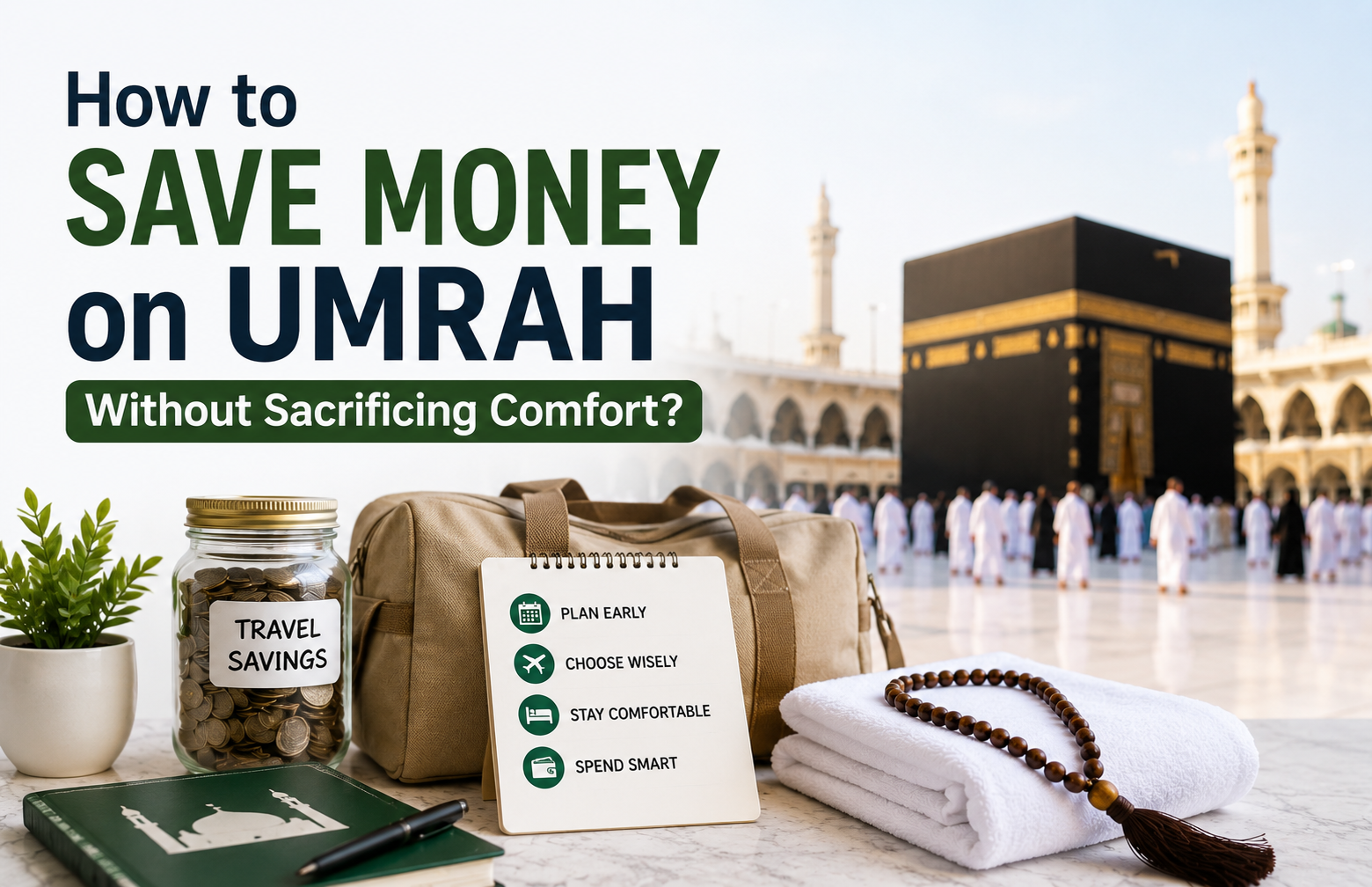
To save money on Umrah without sacrificing comfort, focus on smarter choices rather than simply opting for the cheapest options. The biggest savings usually come from carefully planning flights and accommodation, selecting a package based on overall value, travelling in a group, managing food and transportation costs, and avoiding unnecessary last-minute purchases.
Umrah is a journey of the heart, but it’s also a journey that costs money in terms of flights, accommodation, transport, food and the small extras. These add up quickly once you’re in Makkah and Madinah. With the right planning, pilgrims can cut costs significantly while still enjoying a comfortable, dignified experience.
Here’s a practical, comprehensive guide to saving money on Umrah without giving up comfort. The following steps explain practical ways to reduce expenses while still maintaining a comfortable and meaningful Umrah experience.
1. Book Your Flights Early and Strategically
Airfare is usually the single biggest expense in an Umrah trip and it’s also the one with the most room for savings if you plan.
- Book 2–3 months in advance. Prices tend to rise sharply in the final two to three weeks before departure, especially during Ramadan and school holidays.
- Avoid peak seasons if flexibility allows. Ramadan and the weeks surrounding Hajj are the most expensive times to travel. If your schedule permits, consider performing Umrah during off-peak months like Muharram, Safar, or early Rajab, when flights and hotels can be considerably cheaper.
- Compare indirect routes. A one-stop flight through a Gulf hub (Dubai, Doha, Abu Dhabi) is often significantly cheaper than a direct flight, and the layover can even double as a short rest break.
- Set fare alerts. Use flight comparison tools to track price drops on your specific route rather than checking manually every day.
None of this requires flying in an uncomfortable seat or an unreliable airline so it simply means being strategic about timing.
2. Choose the Right Package Around Budget
Umrah packages vary enormously in what they include and the lowest listed price is not always the best value.
When comparing packages, check exactly what’s included:
- Visa processing fees
- Airport pickup and drop-off
- Ziyarat (guided visits to historical sites)
- Number of nights in Makkah versus Madinah
- Meal plans (some include breakfast only, others full board)
A mid-range package that bundles transport and guided Ziyarat can often work out cheaper and far more comfortable.
3. Be Smart About Hotel Location in Saudi Arabia
This is where many pilgrims either overspend or under-plan. Hotels directly facing the Haram are convenient but carry a steep premium but sometimes two to three times the cost of a hotel just a few streets away.
A better approach is that look for hotels within a 5–10 minute walk of the Haram. You lose a little convenience but gain significant savings, and the short walk is often manageable for most pilgrims, especially if you’re travelling in a group.
If walking distance is a concern due to age, health, or mobility, most mid-range hotels within 500 meters to 1 km of the Haram offer free or low-cost shuttle services. This is frequently a smarter trade-off than paying the premium for a Haram-facing room you’ll barely spend time in, since most of your day will be spent in prayer, not in the hotel.
Tip: Book Madinah hotels a little further from Masjid an-Nabawi than you would in Makkah. Madinah is smaller, walking distances feel shorter, and hotel prices drop faster as you move even one or two streets back.
4. Travel in a Group with Family Members or Friends
Group travel is one of the most effective ways to reduce costs while actually increasing comfort. Sharing a room with family or a trusted group cuts accommodation costs per person substantially, and shared private transport (rather than individual taxis) reduces both cost and the stress of navigating unfamiliar cities.
Many travel agencies offer discounted group rates for parties of four or more, and some negotiate better hotel rates for block bookings. If you’re travelling with extended family or a community group, ask your agent directly whether a group rate is available it’s often not advertised upfront.
5. Time Your Trip to Avoid Crowded and Expensive Periods
During Ramadan and Hajj season, everything such as hotels, food, local transport and even bottled water near the Haram, becomes more expensive due to demand.
Travelling during quieter months means:
- Lower hotel and flight prices
- Shorter queues at the Haram, meaning less physical exhaustion
- More availability for last-minute changes if your plans shift
- A calmer, more reflective worship experience overall
If Ramadan Umrah holds special spiritual significance for you, that’s understandable and worth prioritising regardless of cost.
6. Manage Food Costs Without Compromising Quality
Eating out for every meal near the Haram adds up fast and restaurant prices in tourist-heavy areas are inflated. A few practical adjustments help:
- Choose a hotel with breakfast included. This alone can save a meaningful amount over a 7–10 day trip.
- Look slightly beyond the main tourist strip. Local eateries just a few streets from the Haram often serve the same quality food.
- Buy snacks and water in bulk from local supermarkets rather than small shops directly outside the mosque, where prices are often marked up.
- Consider a light self-catering setup if your hotel room has a kettle or mini-fridge, useful for tea, instant meals, or storing fruit and snacks.
These small changes don’t affect the quality of your trip.
7. Use Local Transport Wisely
Taxis and private cars around Makkah and Madinah can be expensive if booked casually, especially for pilgrims unfamiliar with standard local rates.
- Agree on fares before the ride, or use metered/app-based transport where available, to avoid inflated tourist pricing.
- Use the free shuttle buses that many hotels and some Haram-adjacent zones offer.
- For Ziyarat trips, a shared group taxi or a pre-arranged package tour is usually far cheaper than hiring a private car for each site individually.
8. Pack Smart to Avoid On-Ground Purchases
Many pilgrims end up spending unexpectedly on items they forgot to pack such as comfortable walking sandals, a lightweight prayer mat, a reusable water bottle, portable phone chargers, or basic medication. Buying these last-minute near the Haram usually costs more than buying them at home.
A simple pre-departure checklist of umrah includes comfortable ihram/clothing, good walking shoes, a small first-aid kit, a portable charger, and any personal medication, which prevents the small, avoidable expenses that quietly inflate a trip’s total cost.
9. Set a Daily Budget and Track It
Without a clear daily budget, it’s easy to overspend on convenience purchases: a taxi instead of a short walk, bottled water at premium prices, or impulse souvenir shopping. Setting a simple daily spending limit for food, transport, and extras helps you stay in control without feeling restricted.
Apps or even a simple notebook to track spending against your budget can help you spot where costs are creeping up while you still have time to adjust.
10. Shop for Souvenirs Strategically
Gift and souvenir shopping is often where budgets quietly slip. Prices in shops directly outside the Haram are typically higher than those in nearby markets or slightly further out. If gift shopping is on your list, set it aside for a dedicated trip to a local market rather than picking up items impulsively between prayers, where prices are rarely negotiated and often inflated for tourists.
11. Don’t Overlook Travel Insurance and Currency Exchange
Two often-ignored costs can quietly undo your savings elsewhere: travel insurance and currency exchange rates.
- Travel insurance feels like an extra expense upfront, but skipping it can be far costlier if a medical issue, flight delay, or lost luggage situation arises mid-trip. A basic, reputable policy is inexpensive relative to the protection it offers and can save you from paying full price for emergency care abroad.
- Currency exchange rates at airports are almost always worse than those at local exchanges or banks. Exchanging a small amount for immediate needs at the airport is fine, but changing the bulk of your money once you’re in the city, or using a low-fee travel card, typically gets you a noticeably better rate.
Neither of these affects your day-to-day comfort, but both protect the budget you’ve worked hard to plan.
Final Thoughts
Saving money on Umrah is really about spending intentionally rather than spending less overall. Every pilgrim’s budget and comfort needs are different, and the goal isn’t to cut corners that affect your worship or wellbeing so it’s to identify which expenses genuinely add value (a good night’s sleep, safe transport, nourishing food) and which are simply convenience premiums that can be avoided with a little planning.
With early booking, smart hotel location choices, group travel, and mindful daily spending, it’s entirely possible to have a comfortable, dignified Umrah experience without an inflated price tag. The money saved can often go toward extending your stay, performing an additional Umrah, or simply easing the financial pressure of the trip, leaving more room to focus on what the journey is really about.