For Muslims across the world, few moments are as moving and unforgettable as standing before the Kaaba in Makkah. It is the direction we face in every prayer, the sacred House of Allah ﷻ, and the focal point of the annual Hajj and year-round Umrah. One of the most important acts of worship performed around the Kaaba is Tawaf.
Whether you are preparing for your first Umrah, planning for Hajj, or simply wishing to understand more about Islamic practices, learning about Tawaf can help deepen your appreciation of this beautiful act of devotion.
What Is Tawaf?
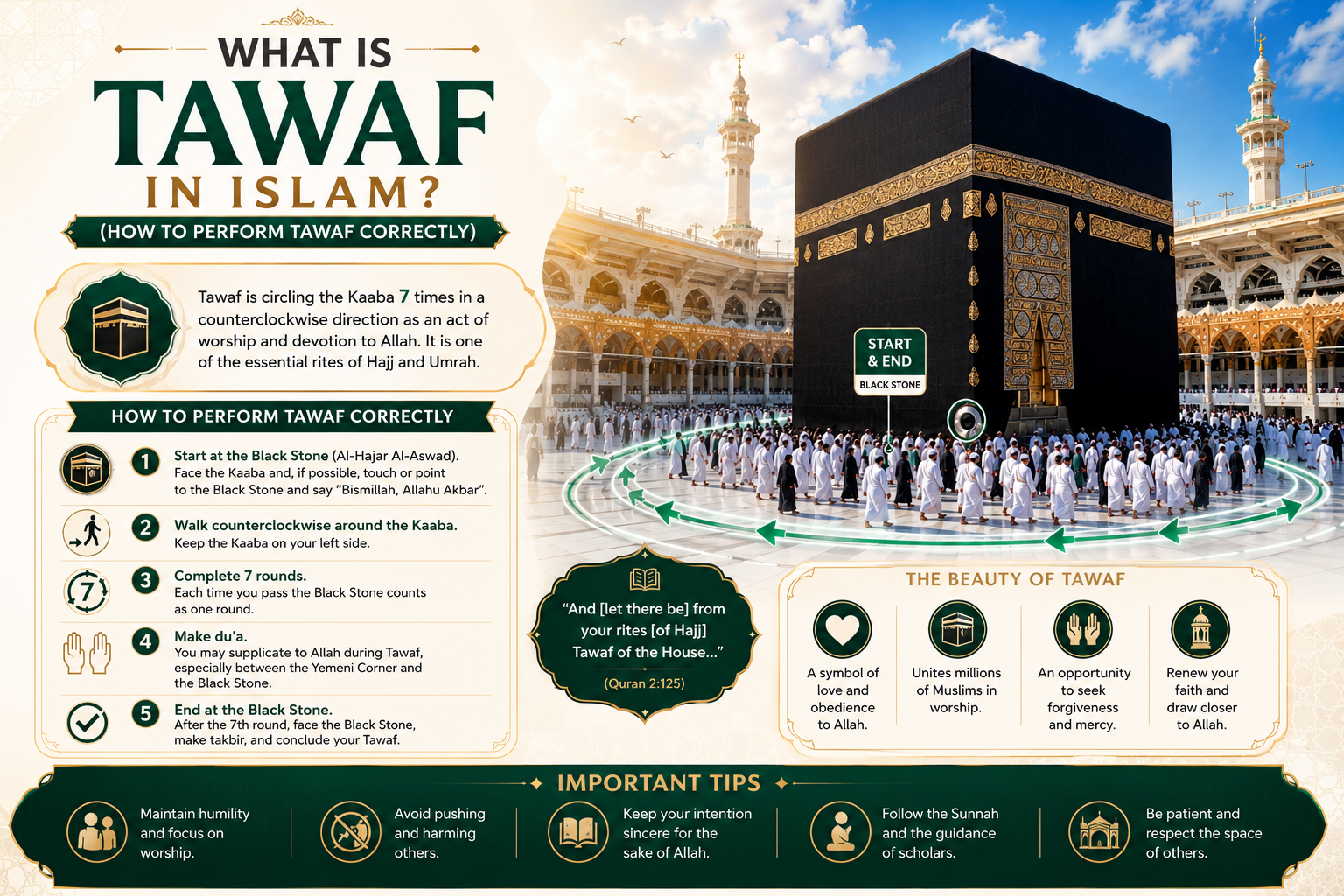
Tawaf is the act of walking around the Kaaba seven times in a counter-clockwise direction while worshipping Allah. It is an essential ritual of both Hajj and Umrah and is performed by millions of Muslims every year.
The word “Tawaf” comes from an Arabic root meaning “to circle” or “to go around.” During Tawaf, Muslims move around the Kaaba while remembering Allah, making du’a, reciting the Qur’an, and reflecting on His greatness.
Tawaf is not merely a physical act. It is an act of worship that symbolises complete submission to Allah. Just as the angels circle around the heavenly House known as Al-Bayt Al-Ma’mur, believers circle the Kaaba in obedience and remembrance of their Lord.
If you are planning your pilgrimage, you may also find our Complete Umrah Guide helpful for understanding each step of the journey from Ihram to completion.
Why Is Tawaf Important?
Tawaf holds a special place in Islam because it is directly connected to the Sacred House established by Prophet Ibrahim (Abraham, peace be upon him) and his son Prophet Ismail (peace be upon him).
Allah says in the Qur’an:
“And purify My House for those who perform Tawaf and those who stand in prayer and those who bow and prostrate.”
(Surah Al-Hajj 22:26)
The act reminds Muslims of the unity of the Ummah. Regardless of nationality, ethnicity, language, or social status, all believers gather around one centre of worship, united in their devotion to Allah.
For many Muslims from the UK, performing Tawaf is often the most emotional moment of Umrah or Hajj. After years of facing the Kaaba in prayer, finally seeing it with one’s own eyes can bring overwhelming gratitude, humility, and tears of joy.
Different Types of Tawaf
There are several types of Tawaf in Islamic practice.
Tawaf Al-Umrah
This Tawaf is performed as part of Umrah and is one of its essential pillars. Without it, Umrah is not complete.
Tawaf Al-Qudum
Known as the Arrival Tawaf, this is performed when pilgrims first arrive in Makkah for Hajj.
Tawaf Al-Ifadah
This is one of the major pillars of Hajj and must be completed by every pilgrim.
Tawaf Al-Wada
Often called the Farewell Tawaf, this is performed before leaving Makkah after completing Hajj.
Nafl Tawaf
Muslims visiting the Haram may perform voluntary Tawaf at any time as an act of worship and closeness to Allah.
Prerequisite Checklist: Preparing for Tawaf
You cannot simply walk into the Mataf and start circling the Kaaba on a whim. There are strict spiritual and physical preparations you must fulfill first.
Conditions Before Performing Tawaf
Before beginning Tawaf, there are several important conditions that should be met.
1. Be in a State of Purity
According to the majority of Islamic scholars, being in a state of valid Wudu (ablution) is an absolute condition for Tawaf. Think of Tawaf as a form of prayer, except that Allah has permitted us to speak and walk during it. If your Wudu breaks mid-Tawaf due to a crowd crush or an upset stomach, you must leave the crowd, renew your Wudu, and return to resume.
2. Cover the Awrah
Your clothing must meet the requirements of Islamic modesty. For brothers, the clothing or Ihram, must cover from the navel to below the knees. For sisters, the entire body must be covered loosely, leaving only the face and hands visible.
3. Have the Correct Intention
As with all acts of worship, sincerity is essential. Make your intention purely for the sake of Allah.
4. Avoid Causing Harm to Others
The Haram can become very crowded. Islam teaches patience, kindness, and consideration for fellow worshippers. Pushing, arguing, or causing difficulty for others should be avoided.
5. Idtiba (For Men Only)
If you are performing a Tawaf that is followed immediately by Sa’ee (the walking between Safa and Marwa, such as during Umrah or arrival), men should practice Idtiba. This means uncovering your right shoulder by passing your upper Ihram sheet under your right armpit and draping it over your left shoulder.
How to Perform Tawaf Correctly?
To perform tawaf correctly, follow these steps:
Step 1: Begin at the Black Stone
Tawaf starts from the corner of the Kaaba where the Black Stone (Hajar Al-Aswad) is located.
Face the Black Stone and begin by saying:
“Bismillah, Allahu Akbar”
If possible, one may kiss the Black Stone, following the Sunnah of the Prophet ﷺ. However, due to crowds, most pilgrims simply point towards it and continue.
There is no need to push through crowds to reach the stone.
Step 2: Start Walking Around the Kaaba
Move in a counter-clockwise direction, keeping the Kaaba on your left side.
Each complete circuit around the Kaaba counts as one round.
A total of seven rounds must be completed.
Step 3: Engage in Dhikr and Du’a
There is no specific du’a required for every round.
Pilgrims may:
- Recite the Qur’an
- Make personal supplications
- Say SubhanAllah
- Say Alhamdulillah
- Say Allahu Akbar
- Send blessings upon the Prophet ﷺ
- Ask Allah for forgiveness and guidance
One of the beautiful aspects of Tawaf is the freedom to speak to Allah in your own words and language.
Many UK Muslims find this especially comforting, as du’a can be made in English as well as Arabic.
Step 4: Between the Yemeni Corner and the Black Stone
A well-known supplication often recited in this section is:
“Rabbana atina fid-dunya hasanah wa fil-akhirati hasanah wa qina ‘adhaban-nar.”
Meaning:
“Our Lord, grant us good in this world and good in the Hereafter and protect us from the punishment of the Fire.”
This du’a is commonly recited during each circuit as pilgrims move between the Yemeni Corner and the Black Stone.
A Crucial Note on the Hatim (Hijr Ismail): The semi-circular wall adjacent to the Kaaba is actually part of the original foundations of the Kaaba built by Ibrahim (peace be upon him). Therefore, you must walk outside of this wall during your Tawaf. Walking inside the Hatim cuts through the Kaaba itself, which completely invalidates that specific circuit.
Top Practical Tips for British Pilgrims
Travelling from the UK to the intense heat and massive crowds of Makkah can be a profound shock to the system. Here is some grounded, practical advice from someone who understands the transition:
Beat the Heat and Crowds
If you are performing a voluntary Nafl Tawaf, look to do it late at night (between 11 PM and 2 AM) or immediately after the Ishraq (post-sunrise) period. Avoid the afternoon sun at all costs. The white marble of the Mataf floor stays miraculously cool due to internal chilling systems, but the sheer atmospheric heat of midday can sap your energy rapidly, leading to dehydration.
Managing Your Wudu
The lower floor of the Mataf gets incredibly packed. It is very common to get bumped or stepped on. If your Wudu breaks, do not panic. Head toward the designated exit ramps that lead to the underfloor ablution blocks. Trying to push back into the tight crowd after renewing your Wudu can be stressful, so take your time and stay calm.
Keep Your Eyes on Your Footing
It is natural to want to look up at the stunning cloth of the Kaaba (the Kiswah) throughout your journey, but always remain highly aware of your immediate surroundings. Pilgrims in wheelchairs navigate specialized tracks or the upper floors, but occasionally individuals may use the main floor. Watch out for sudden stops by people ahead of you who are attempting to take photos or catch a glimpse of the Black Stone.
Final Thoughts
When your feet are sore, the skin on your soles feels raw from the marble, and you are feeling exhausted from the flight from Manchester or Heathrow, take a deep breath. Look at the Kaaba. Remind yourself of who invited you here. You are a guest of Allah (Dhuyuf al-Rahman).
Tawaf is a golden, unparalleled opportunity to wipe your slate clean. It is where tears flow freely without judgement, where the burdens of our stressful lives back home in the UK are lifted, and where we find true spiritual alignment. Approach it with humility, maintain the utmost respect for your fellow brothers and sisters in the crowd, and may Allah accept your Umrah, your Hajj, and your Duas.